

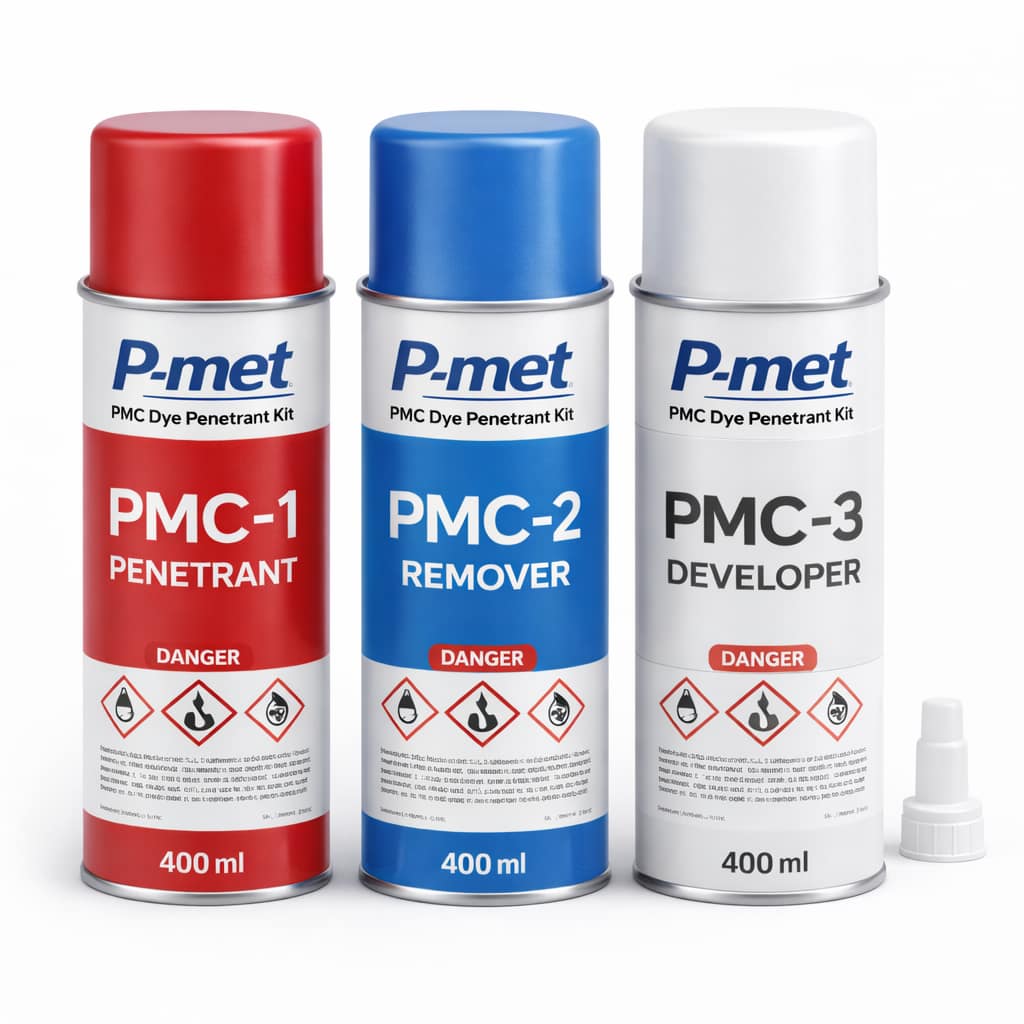
The P-MET PMC FLAWCHECK Dye Penetrant Inspection Kit is a professional-grade NDT system that detects surface defects as small as 1 micron. This solvent-removable kit includes PP-110B red penetrant, PC-120B cleaner, and PD-130B developer in 400ml aerosol cans.
Certified to ASTM E1417, ASME Section V, and ISO 3452 standards with NPCIL, DGCA, and DGAQA approvals. Ideal for aerospace, nuclear, automotive, and industrial applications requiring precision flaw detection of cracks, porosity, and surface discontinuities.
What is the PMC FLAWCHECK Dye Penetrant Inspection Kit?
The PMC FLAWCHECK 3-Digit Series is a complete liquid penetrant testing (LPT) system engineered for non-destructive examination of non-porous materials. Liquid penetrant inspection is one of the most widely used NDT methods for detecting surface-breaking defects that may not be visible to the naked eye, including fatigue cracks, stress fractures, porosity, cold shuts, and lack of fusion.
Unlike ultrasonic or radiographic testing, dye penetrant inspection works on the principle of capillary action—the penetrant is drawn into surface openings, then highlighted using a contrasting developer to create a visible indication of the defect’s size and location. This makes it ideal for field inspections, in-process quality control, and maintenance examinations where portability and rapid results are essential.
How PMC FLAWCHECK Works
The three-component system operates through a controlled sequence:
- Surface Preparation: The test surface is cleaned using PC-120B solvent cleaner to remove contaminants such as oil, grease, dirt, and oxidation that could block penetrant entry
- Penetrant Application: PP-110B visible red penetrant is applied and allowed to dwell, enabling capillary forces to draw the liquid into surface-breaking discontinuities
- Excess Removal: Excess penetrant is carefully removed from the surface using the solvent remover, without extracting penetrant trapped within defects
- Development: PD-130B developer is applied, acting as a blotter to draw out trapped penetrant and create high-contrast indications
- Inspection: Defects appear as bright pink-red indications against the white developer background under normal daylight or white light
This systematic approach ensures consistent, repeatable results across diverse materials including metals, ceramics, glass, and certain plastics.
Why This Matters for Critical Applications
In aerospace, nuclear power, petrochemical, and automotive industries, undetected surface defects can lead to catastrophic failures. A hairline crack in a turbine blade, a stress fracture in a weld, or porosity in a casting can compromise structural integrity and safety. PMC FLAWCHECK provides quality assurance teams, MRO facilities, and manufacturing plants with a reliable, cost-effective method to verify component condition before parts enter service or return to operation after maintenance.
The kit’s sensitivity to detect defects as small as 1 micron width × 20 micron depth on standard Ni-Cr test panels makes it suitable for the most demanding inspection requirements. This level of detection capability is critical when inspecting high-value components where even microscopic flaws could propagate under stress or thermal cycling.
Technical Information
System Components & Chemistry
PP-110B Penetrant (Visible Red Dye)
- Type: Solvent-based visible penetrant (Type II, Method C per ASTM E1417)
- Color: Pinkish-red in daylight
- Sensitivity Classification: Level 2 (high sensitivity for crack detection)
- Detection Capability: 1 micron width × 20 microns depth on Ni-Cr test panel
- Formulation: Petroleum hydrocarbon solvent base with red dye particles
- Flash Point: >93°C (200°F) – safe for most industrial environments
- Halide Content: Low (<1000 ppm chlorides + fluorides)
- Sulfur Content: Low (<1000 ppm) - safe for titanium and high-nickel alloys
PC-120B Cleaner/Remover (Non-Halogenated Solvent)
- Type: Non-chlorinated solvent blend
- Function: Dual-purpose pre-cleaner and penetrant remover
- Drying Time: Fast-evaporating for rapid inspection cycles
- Safety: Non-toxic, non-corrosive formulation
- Flash Point: >21°C (70°F)
- Environmental: Free of chlorinated solvents and ozone-depleting substances
PD-130B Developer (Non-Aqueous)
- Type: Solvent-suspended white powder developer
- Application: Aerosol spray for uniform coating
- Contrast: High white opacity for maximum indication visibility
- Drying Time: Forms dry, white coating within minutes
- Removability: Easily cleaned after inspection
Operating Principle
Liquid penetrant testing exploits the physical property of capillarity—the ability of liquids to flow into narrow spaces without external forces. The penetrant’s low surface tension and high wetting ability allow it to enter defects with openings as small as 1 micron. After excess surface penetrant is removed, the developer’s reverse capillary action draws trapped penetrant back to the surface, creating an indication larger than the actual defect for enhanced visibility.
Product Specifications
| Specification | PP-110B Penetrant | PC-120B Cleaner | PD-130B Developer |
|---|---|---|---|
| Pack Size | 400 ml aerosol can | 400 ml aerosol can | 400 ml aerosol can |
| Color/Appearance | Pinkish-red liquid | Clear solvent | White suspended powder |
| Detection Sensitivity | 1µ width × 20µ depth | N/A | N/A |
| Formulation | Petroleum hydrocarbon solvent base | Non-halogenated solvent blend | Non-aqueous white developer |
| Flash Point | >93°C (200°F) | >21°C (70°F) | N/A (non-flammable suspension) |
| Halide Content | <1000 ppm (Cl + F) | <1000 ppm | <1000 ppm |
| Sulfur Content | <1000 ppm | <1000 ppm | <1000 ppm |
| Toxicity | Non-toxic | Non-toxic | Non-toxic |
| Application Method | Aerosol spray or brush | Aerosol spray or wipe | Aerosol spray |
| Dwell Time (Typical) | 5-30 minutes | N/A | 5-10 minutes drying |
| Shelf Life | 24 months from manufacture | 24 months from manufacture | 24 months from manufacture |
Standards Conformance
| Standard/Code | Compliance Status | Relevance |
|---|---|---|
| ASTM E1417-21 | ✓ Compliant | Standard practice for liquid penetrant testing |
| ASME Section V, Article 6 | ✓ Compliant | Boiler and pressure vessel code for NDT |
| ISO 3452 | ✓ Compliant | International standard for penetrant testing |
| IS 3658-1981 | ✓ Compliant | Indian standard code of practice for liquid penetrant flaw detection |
| AMS 2644 | Compatible | Aerospace material specification for penetrant materials |
| MIL-STD-6866 | Compliant (now replaced by ASTM E1417) | Former military standard for penetrant inspection |
Material Compatibility
Suitable for inspection of:
- Ferrous metals (steel, stainless steel, cast iron)
- Non-ferrous metals (aluminum, titanium, magnesium, copper alloys, nickel alloys)
- Ceramics and glass
- Certain plastics and composites (pre-testing recommended)
- Welds, castings, forgings, machined parts
Not suitable for:
- Porous materials (concrete, wood, unglazed ceramics)
- Surfaces with active bleeding (oils, greases, or chemicals seeping from within)
Key Features & Benefits
🔬 Ultra-High Detection Sensitivity
Detects surface-breaking defects as small as 1 micron width × 20 micron depth on Ni-Cr test panels—ideal for critical aerospace components where microscopic cracks can lead to catastrophic failures during flight operations or thermal cycling.
✅ Multi-Industry Standards Compliance
Conforms to ASTM E1417, ASME Section V Article 6, ISO 3452, and IS 3658 standards, ensuring your inspection results meet regulatory requirements for aerospace (FAA/EASA), nuclear (NRC/AERB), and pressure vessel codes worldwide.
🏭 Trusted by Critical Infrastructure Operators
Approved by Nuclear Power Corporation of India (NPCIL), Director General of Civil Aviation (DGCA), Directorate General of Aeronautical Quality Assurance (DGAQA), and Research Designs & Standards Organization (RDSO-Indian Railways)—demonstrating proven reliability in the most demanding applications.
🧪 Non-Toxic, Non-Corrosive Formulation
Safe for use on exotic alloys including titanium, Inconel, and high-nickel materials with low halide (<1000 ppm) and sulfur (<1000 ppm) content, preventing stress corrosion cracking in sensitive materials.
⚡ Rapid Inspection Cycle
Fast-drying solvent remover and developer enable complete inspection cycles in 15-30 minutes, minimizing aircraft ground time, production line delays, and equipment downtime during maintenance inspections.
🌍 Portable & Field-Ready
Convenient 400ml aerosol cans eliminate the need for spray guns, air compressors, or mixing equipment—perfect for remote locations, offshore platforms, construction sites, and mobile inspection teams.
🔴 Excellent Daylight Visibility
Bright pinkish-red penetrant against white developer background provides high contrast under normal lighting conditions—no UV lamps required, simplifying inspections in areas without electrical power.
💰 Cost-Effective Quality Assurance
Significantly more economical than radiographic or ultrasonic testing while delivering reliable detection of surface defects, making it ideal for high-volume production environments and budget-conscious MRO operations.
Applications
Aerospace & Aviation
- Aircraft Structural Inspections: Detecting fatigue cracks in airframes, landing gear, wing spars, and fuselage joints
- Turbine Engine Components: Inspecting turbine blades, compressor discs, and combustion chambers
- Weld Quality Control: Verifying weld integrity in fuel tanks, hydraulic systems, and structural repairs
- MRO Facilities: Component overhaul inspection for airlines, helicopter operators, and military aviation
Nuclear & Power Generation
- Reactor Vessel Inspections: Detecting cracks in reactor pressure vessels, steam generators, and coolant piping (NPCIL approved)
- Welded Joints: In-service inspection of critical welds per ASME Section XI requirements
- Heat Exchanger Tubes: Surface crack detection during periodic maintenance shutdowns
- Safety-Critical Components: Quality assurance for pressure boundaries and emergency core cooling systems
Automotive & Transportation
- Engine Block & Cylinder Head Inspection: Detecting porosity and cracks in aluminum and cast iron components
- Transmission & Gearbox Components: Inspecting gears, shafts, and housings for fatigue cracks
- Chassis & Frame Welds: Quality control during manufacturing and accident damage assessment
- Railway Components: Wheel sets, axles, couplers, and structural members (RDSO approved for Indian Railways)
Oil & Gas / Petrochemical
- Pipeline Weld Inspection: Detecting lack of fusion, porosity, and cracks in field welds
- Pressure Vessel Fabrication: Quality control per ASME Section VIII requirements
- Offshore Platform Structures: Inspecting welds and structural joints exposed to corrosive marine environments
- Refinery Equipment: Periodic inspection of piping, flanges, and process equipment
Manufacturing & General Industry
- Castings & Forgings: Detecting surface porosity, cold shuts, and cracks in foundry products
- Machined Components: Identifying grinding cracks, tool marks, and surface tears
- Welding Quality Control: In-process and final inspection of structural steel, stainless steel, and aluminum welds
- Tool & Die Inspection: Detecting fatigue cracks in molds, dies, and production tooling
How to Use – Step-by-Step Inspection Procedure
Pre-Inspection Preparation
Step 1: Surface Cleaning
- Spray PC-120B cleaner onto the inspection surface
- Remove all oil, grease, dirt, rust, paint, scale, and other contaminants
- Allow surface to dry completely (2-5 minutes)
- Ensure surface is at room temperature (15-50°C / 60-120°F)
Important: Inadequate surface preparation is the #1 cause of missed defects. The surface must be completely clean and dry for penetrant to enter defects.
Penetrant Application
Step 2: Apply Penetrant
- Shake PP-110B can vigorously for 30 seconds
- Hold can 20-30 cm (8-12 inches) from surface
- Apply uniform wet coat covering the entire inspection area
- Ensure complete coverage without excessive pooling
Step 3: Dwell Time
- Allow penetrant to dwell: 5-30 minutes depending on material and defect type
- Minimum 5 minutes: Most metals at room temperature
- 10-15 minutes: Tight cracks, cold materials
- 20-30 minutes: Deep defects, rough surfaces
- Keep surface wet during dwell; reapply if penetrant dries
Penetrant Removal
Step 4: Remove Excess Penetrant
- Spray PC-120B cleaner onto clean, lint-free cloth (not directly onto part)
- Wipe surface gently to remove excess penetrant
- Continue wiping until surface appears clean (faint pink stain acceptable)
- Critical: Do not over-clean; this can remove penetrant from defects
Developer Application
Step 5: Apply Developer
- Shake PD-130B can well to mix suspended powder
- Hold can 30-40 cm (12-16 inches) from surface
- Apply thin, uniform white coating
- Allow developer to dry (5-10 minutes)
Inspection & Interpretation
Step 6: Visual Examination
- Inspect surface under good lighting (minimum 500 lux / 50 foot-candles)
- Look for bright pink-red indications against white background
- Relevant indications will:
- Bleed out gradually (not appear instantly)
- Have distinct edges and defined shapes
- Grow in size over 5-10 minutes
Indication Types:
- Linear indications: Cracks, laps, seams
- Rounded indications: Porosity, pits
- Broad, irregular: Surface roughness, non-relevant indications
Step 7: Documentation
- Photograph or mark indication locations
- Measure indication dimensions
- Compare against acceptance criteria (per drawing or code requirements)
Post-Inspection Cleaning
Step 8: Final Cleaning
- Remove developer coating with PC-120B cleaner
- Clean surface thoroughly to prevent contamination
- Dispose of used materials per local regulations
Inspection Cycle Summary
| Phase | Duration | Total Time |
|---|---|---|
| Surface cleaning | 2-5 min | 5 min |
| Penetrant application | 1 min | 6 min |
| Penetrant dwell | 10-15 min | 21 min |
| Excess removal | 2-3 min | 24 min |
| Developer application | 1 min | 25 min |
| Developer drying | 5-10 min | 35 min |
| Inspection | 5-15 min | 50 min |
| Total typical cycle | 30-50 minutes | |
Additional Information
Storage & Handling
- Storage Temperature: 5°C to 40°C (41°F to 104°F) in dry, well-ventilated area
- Shelf Life: 24 months from date of manufacture when stored properly
- Pressurized Containers: Store away from heat sources, sparks, and open flames
- After Opening: Use within 12 months for optimal performance
- Disposal: Follow local regulations for aerosol can disposal; do not puncture or incinerate
Safety & Regulatory Information
- Hazard Classification: Aerosol Category 1 (pressurized container)
- OSHA Requirements: Use in well-ventilated areas; avoid prolonged inhalation
- PPE Recommended: Safety glasses, chemical-resistant gloves for skin protection
- First Aid: In case of eye contact, flush with water for 15 minutes; if swallowed, do not induce vomiting—seek medical attention
- Environmental: Contains no ozone-depleting substances; low VOC formulation
Quality Assurance & Manufacturing
P-MET High-Tech Company Pvt. Ltd. manufactures PMC FLAWCHECK products under stringent quality control protocols:
- ISO 9001 certified manufacturing facility
- Batch testing on standard Ni-Cr test panels
- Technical collaboration with Sherwin Inc., USA
- Lot traceability for all components
- Regular third-party verification testing
Packaging & Commercial Details
Kit Contents
Each PMC FLAWCHECK 3-Digit Series Kit includes:
- 1 × PP-110B Penetrant (400 ml aerosol can)
- 1 × PC-120B Cleaner/Remover (400 ml aerosol can)
- 1 × PD-130B Developer (400 ml aerosol can)
Total Kit Weight: ~1.5 kg (3.3 lbs)
Packaging: Shrink-wrapped set in cardboard carton
Coverage Area (Approximate)
Coverage varies with application method and surface condition:
- Penetrant (PP-110B): 2-3 m² (20-30 sq ft) per 400ml can
- Cleaner (PC-120B): 3-4 m² (30-40 sq ft) per 400ml can
- Developer (PD-130B): 2-3 m² (20-30 sq ft) per 400ml can
Typical Kit Coverage: 15-20 small to medium components or 2-3 m² of continuous surface
Available Packaging Options
- Single Kit: 3 cans (1 each: Penetrant, Cleaner, Developer) – 400ml
- Bulk Packaging: Available in 1-liter aerosol cans (industrial volume)
- Custom Kits: Contact sales for project-specific quantities
Product Cross-Reference
P-MET Product Family
3-Digit Series (This Kit):
- PP-110/PP-110B (Penetrant)
- PC-120/PC-120B (Cleaner)
- PD-130/PD-130B (Developer)
Other P-MET Series:
- 2-Digit Series: PP-15B, PC-21B, PD-31B (water-washable base)
- 4-Digit Series: PP-5011B, PC-5021B, PD-5031B (economy line)
Compatible/Equivalent Specification Codes
While exact cross-references should be verified, the following products offer similar solvent-removable visible penetrant capabilities:
- Sherwin Dubl-Chek DP-40/DR-60/D-100 series
- Magnaflux Spotcheck SKL-SP2/SKC-S/SKD-S2
- Met-L-Chek DP-50 series
- Ardrox 9PD1B series (Chemetall)
Note: Always verify compatibility and qualification requirements when substituting products, especially in aerospace and nuclear applications where specific product approvals may be required.
Reviews
There are no reviews yet.